

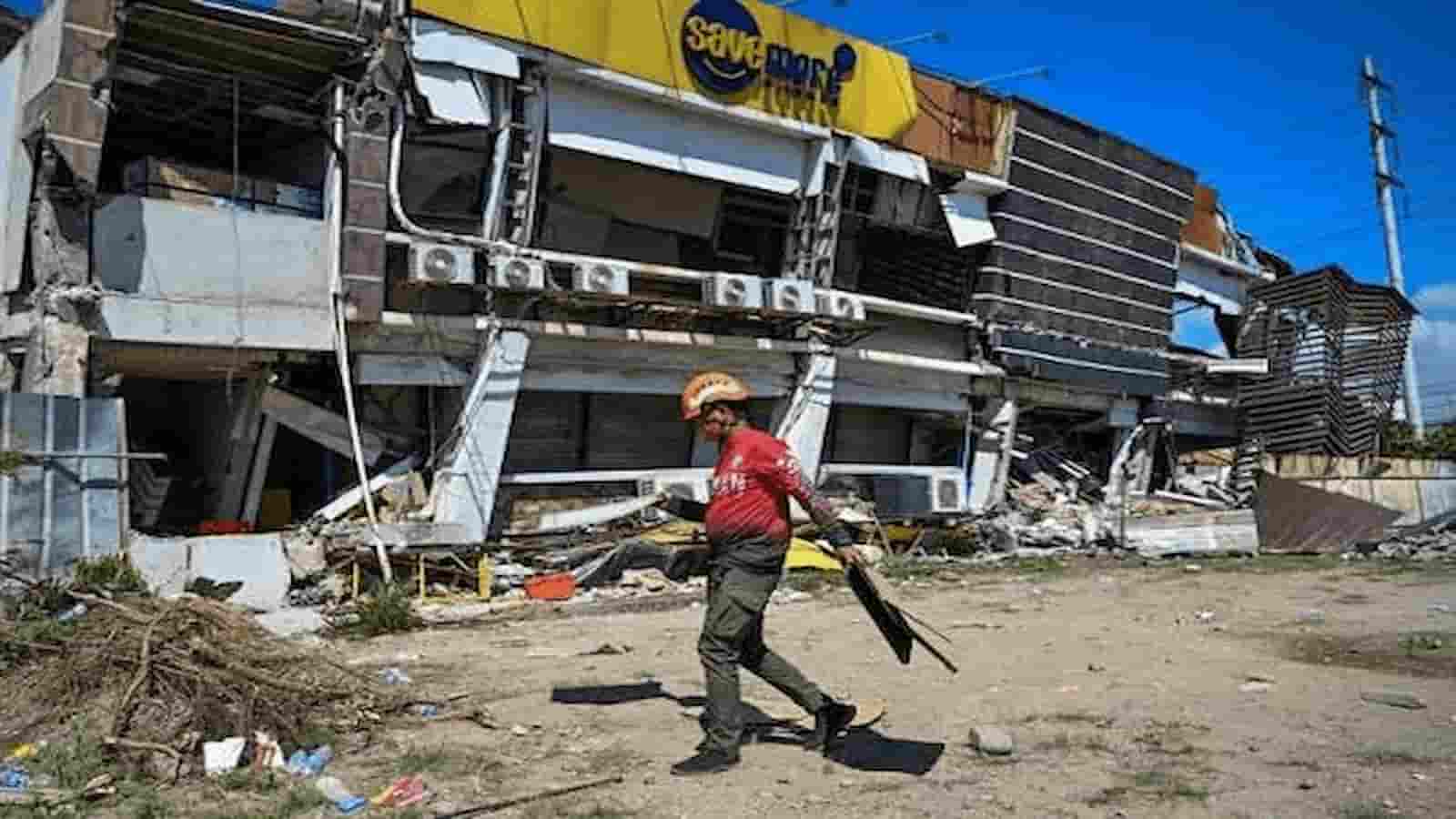
The death toll from the powerful 7.8-magnitude earthquake that struck off the coast of Mindanao Island in the Philippines on June 8, 2026, has climbed rapidly to 41, as rescuers continue to search through collapsed buildings and landslide-hit communities. The devastating earthquake reduced multi-story structures to rubble, split roads apart, and triggered widespread panic across the region after serious tsunami warnings were issued for coastal areas.
Conditions remained critical on Tuesday. According to national and local disaster management agencies, more than 450 people have suffered serious injuries, while thousands have been displaced from their homes. Several areas in the heavily affected Sarangani Province have been completely cut off from the mainland, leaving helicopters as the only means of access. Continuous powerful aftershocks have further complicated rescue and relief operations.
One of the most severe consequences of the disaster has been the collapse of healthcare infrastructure. Hospitals in General Santos City and surrounding areas sustained extensive structural damage, forcing medical personnel to treat patients outdoors under temporary tents and makeshift facilities.
Outside the Sarangani Provincial Hospital, hundreds of patients have been placed on beds under the scorching sun after large cracks appeared in the hospital building. Municipal engineers declared the structure unsafe, warning that keeping patients inside could be life-threatening.
Amid the chaos and destruction, a remarkable scene unfolded outside a hospital in General Santos. Behind a temporary screen and with the assistance of doctors, a young mother gave birth to a healthy baby under the open sky. The newborn's arrival brought a rare moment of hope and relief to rescue workers and residents struggling through the disaster.
At another hospital in Glan Municipality, staff members reported that more than 60 patients were evacuated outdoors due to fears of further structural collapse. Medical treatment continues in temporary open-air facilities.
The 7.8-magnitude earthquake also triggered devastating landslides in mountainous regions. In the Glan area, a massive landslide buried at least 13 people alive inside their homes. Since Tuesday morning, rescue teams equipped with search dogs and advanced detection equipment have been working to remove debris and locate survivors.
In General Santos City, emergency crews are conducting a search operation outside a collapsed grocery store where two employees remain missing beneath heavy concrete slabs and twisted steel reinforcement bars. Officials acknowledged that the operation is increasingly shifting from rescue to recovery, as the likelihood of finding survivors diminishes with each passing hour.
Two individuals also remain missing from a coastal resort after seawater became violently turbulent during the earthquake. High-speed Coast Guard vessels are continuing search operations in the affected waters.
Several harrowing videos from the disaster have circulated widely on social media and have been verified by international news agency AFP. One video shows a well-known multi-story shopping center in General Santos collapsing within seconds, including a popular fast-food restaurant located inside the complex.
Another emotionally charged video captures primary school children screaming in fear and clinging to their female teachers as powerful tremors violently shake the ground beneath them. The footage concludes with a metal structure inside the school premises collapsing during the earthquake.
Immediately after the earthquake, tsunami high-alert advisories were issued by authorities in the Philippines, Indonesia, Japan, and regional Pacific warning centers. Thousands of residents living in coastal communities were ordered to evacuate to higher ground.
By Tuesday afternoon, the tsunami threat had subsided and all warnings were withdrawn. Japan's Pacific coastline recorded only minor tsunami waves measuring approximately 20 centimeters, resulting in no reported damage.
The Philippines is no stranger to seismic disasters. The country lies along the Pacific Ring of Fire, one of the world's most active zones for earthquakes and volcanic eruptions due to intense tectonic activity.
In October 2025, eastern Mindanao was struck by back-to-back earthquakes measuring 7.4 and 6.7 in magnitude, killing at least eight people. However, the current 7.8-magnitude earthquake ranks among the most powerful to hit the country in decades, causing widespread destruction and severely damaging critical infrastructure across the region.
The disaster has exposed the vulnerability of communities and essential services in one of the world's most seismically active regions. As rescue teams race against time and thousands remain displaced, the full scale of the catastrophe continues to unfold across Mindanao.
About The Author







Comment List